|
WORK IN PROGRESS This page is currently incomplete and will be updated to include further historical information - if you can help with additions, corrections or photos please do get in touch |
|
WORK IN PROGRESS This page is currently incomplete and will be updated to include further historical information - if you can help with additions, corrections or photos please do get in touch |
Last Updated : April 29th 2026 (brought up-to-date)
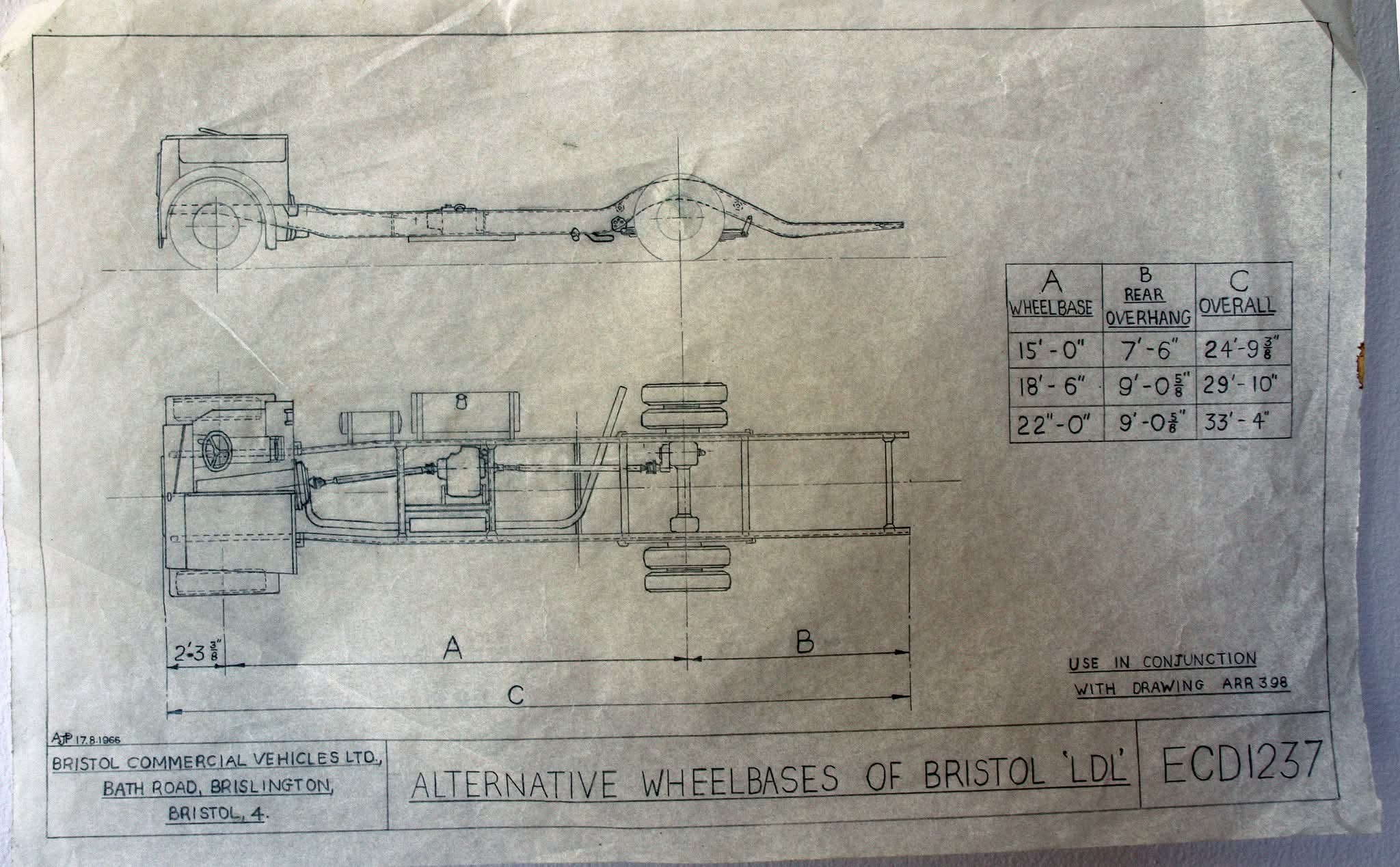
In 1957 Bristol decided to construct some prototype long LD Lodekkas in order to test a larger road footprint; these were some three feet longer than the standard LD chassis. They were all constructed as part of Sanction 134 and were delivered as follows:
| Chassis | Registration |
Company/Fleet Number |
| 134102 |
VDV752 |
Western National 1935 |
| 134103 |
UEL727 |
Hants & Dorset 1406 |
| 134104 |
VDV753 |
Western National 1936 |
| 134127 |
13DRB |
Notts & Derby 464 |
| 134128 |
NBL736 |
Thames Valley 779 |
| 134153 |
YHT962 |
Bristol Omnibus L8450 |
These Lodekkas have been classified as LDL6Gs for
very many years in enthusiast publications. However, there was some
contradictory material published by the Bristol works in 1957, some
suggesting that the LDL6G designation was correct and some giving the
chassis type as LLD6G. This latter classification has been largely
ignored in the succeeding years, but in 2017 the chassis plate of
VDV753 was physically inspected and shown to be stamped LLD6G.
Therefore the designations are considered to be interchangeable for the
purposes of this website.